


SOLUTION DETAILS
2025-12-01
How to Perform Soxhlet Extraction with Petroleum Ether (Step-by-Step Guide)
I. Core Equipment and Reagents
(I) Main Equipment
| Equipment Name | Specification Requirements | Purpose |
|---|---|---|
| Six-unit Soxhlet Extractor | Equipped with 6 sets of condenser tubes, extraction cylinders, and receiving flasks | Core device for solvent reflux and siphon-based repeated extraction |
| Analytical Balance | Precision of 0.0001g | Accurately weigh samples, empty flasks, and final fat-containing flasks |
| Blast Drying Oven | Temperature range: 50-200℃; precision: ±1℃ | Dry samples (remove moisture) and evaporate residual solvent from extracts |
| Quartz Sand/Anhydrous Sodium Sulfate | Analytical grade; pre-dried at 105℃ for 2h and cooled | Quartz sand disperses samples (increases solvent contact area); anhydrous sodium sulfate absorbs moisture |
| Fat-Free Filter Paper | Medium speed; diameter matching the extraction cylinder (or custom filter paper cartridges) | Wrap samples to prevent solid particles from entering the receiving flask |
| Desiccator | Equipped with color-changing silica gel desiccant | Cool dried samples/flasks to avoid moisture absorption |
| Receiving Flask | 150mL/250mL; compatible with the extractor; ground glass joint | Hold extraction solvent and dissolved fats; requires pre-weighing to constant mass |
| Graduated Cylinder | 50mL/100mL | Measure extraction solvent accurately |
| Beaker | 100mL/250mL | Transfer samples and dissolve auxiliary reagents |
| Glass Stirring Rod | Standard specification | Stir and transfer samples |
| Tweezers | Pointed tip | Handle filter paper cartridges and receiving flasks (avoid hand contact) |
| Fume Hood | Explosion-proof type | Provide safe operation space; remove flammable/toxic solvent vapors |
(II) Reagents
- Extraction Solvent (selected based on lipid polarity; all analytical grade, pre-distilled to remove moisture/impurities):
- Petroleum ether (boiling range: 30-60℃ or 60-90℃): Preferred for non-polar fats (animal fats, vegetable oils) due to high volatility and low residue.
- Diethyl ether (boiling range: 34-36℃): High extraction efficiency but flammable and hygroscopic (requires drying with anhydrous calcium chloride).
- Mixed solvents (e.g., petroleum ether-diethyl ether = 1:1): Suitable for samples with both polar and non-polar lipids.
- Anhydrous Ethanol (optional): Cleans water-soluble impurities (sugars, proteins) in samples to reduce extraction interference.
II. Pre-Experiment Preparation
(I) Weighing Receiving Flasks to Constant Mass
- Take 6 clean receiving flasks, rinse with distilled water, and dry in a blast drying oven at 105℃ for 2h.
- Use tweezers to transfer flasks to a desiccator and cool to room temperature (≈30min).
- Weigh each flask with an analytical balance and record the mass as m₀ (unit: g).
- Repeat "drying (1h) → cooling → weighing" until the mass difference between two consecutive weighings is ≤0.0002g (ensures no residual moisture affects results).
(II) Sample Pretreatment
- Sample Drying & Crushing: Crush the sample (grains, meat, Chinese medicinal materials) and sieve through a 40-mesh screen (smaller particles enhance solvent contact). Weigh 5-10g of the sieved sample (record as m₁) and dry at 105℃ for 4h to remove moisture (prevents solvent emulsification).
- Sample Wrapping: Mix the dried sample with 1-2g of anhydrous sodium sulfate (absorbs residual moisture). Place the mixture into fat-free filter paper and fold into a cylindrical cartridge (height slightly lower than the extraction cylinder to avoid overflow). Tie the opening tightly with cotton thread (avoid iron wire, which may cause metal ion interference).
- Filter Paper Cartridge Pretreatment: Rinse the cartridge with a small amount of extraction solvent (removes trace fats in the filter paper) and air-dry before use.III. Step-by-Step Operating Procedures
III. Step-by-Step Operating Procedures
Step 1: Equipment Assembly
- Connect pre-weighed (constant mass) receiving flasks (m₀) to the extractor’s bottom ground glass joints. Apply a thin layer of vacuum grease for tight sealing (avoid excessive force to prevent joint damage).
- Place the pretreated filter paper cartridge (with sample) into the extraction cylinder, ensuring a gap between the cartridge bottom and the cylinder base (facilitates siphoning).
- Add extraction solvent (e.g., petroleum ether) to each cylinder until the liquid level submerges the cartridge top by 1-2cm (ensures full sample immersion).
- Attach the condenser tube to the extraction cylinder’s top joint. Turn on the cooling water (inlet at the bottom, outlet at the top) and adjust the flow rate to eliminate visible solvent vapor on the condenser inner wall (prevents pressure instability from excessive flow).
Step 2: Set Extraction Parameters
- Turn on the extractor power and set the heating temperature: 40-50℃ for 30-60℃ boiling range petroleum ether; 35-40℃ for diethyl ether (avoid overheating to prevent solvent bumping).
- Set the extraction time: 6-12h for most samples (or 20-30 siphon cycles, 3-5 cycles per hour). Extend to 12-16h for high-fat samples (e.g., fatty meat).
Step 3: Initiate Extraction (Solvent Reflux & Siphoning)
- Start the extractor: The heating module heats the solvent, which evaporates, rises to the condenser, condenses into liquid, and drips back to immerse the sample.
- When the solvent level reaches the siphon height, the solvent-fat mixture siphons into the receiving flask.
- Repeat the "evaporation → condensation → immersion → siphoning" cycle: Solvent recycles, while fats remain in the flask (maximizes extraction efficiency).
- Conduct regular checks during extraction:
- Ensure cooling water flows normally (water cutoff causes solvent loss and safety risks).
- Inspect joints for solvent leakage (if leakage occurs, turn off heating and reseal after cooling).
- Monitor solvent color in the flask (a shift from turbid to clear indicates near-complete extraction).
Step 4: Complete Extraction & Recover Solvent
- After reaching the set time, turn off the heating module and continue cooling water flow for 10min (condenses residual solvent vapor).
- Turn off cooling water, disassemble the condenser tube and extraction cylinder, and rinse the condenser inner wall with a small amount of fresh solvent (recovers residual fat).
- Disassemble the receiving flask and place it in a fume hood (with ventilation on) for 1-2h to allow natural solvent evaporation (until no solvent odor remains).
- For rapid recovery, use a rotary evaporator (30-40℃, vacuum degree 0.08MPa) to distill the solvent (reusable after re-distillation).
Step 5: Weigh Fat to Constant Mass & Calculate Content
- Place the flask (with residual fat) into a blast drying oven and dry at 105℃ for 2h (removes residual solvent).
- Transfer the flask to a desiccator, cool to room temperature, and weigh accurately (record as m₂, unit: g).
- Repeat "drying (1h) → cooling → weighing" until the mass difference is ≤0.0002g (confirms constant mass).
- Calculate crude fat content (mass fraction):
plaintext
Crude Fat Content (%) = [(m₂ - m₀) / m₁] × 100%- m₂ - m₀: Mass of extracted fat (g)
- m₁: Dry mass of the sample (g)
IV. Post-Experiment Cleaning & Key Precautions
(I) Equipment Cleaning
- Rinse the extraction cylinder and condenser tube with a small amount of ethanol, followed by 2-3 distilled water rinses. Air-dry for reuse.
- For reusable receiving flasks: Soak in chromic acid cleaning solution for 2h (removes residual fat), rinse with distilled water until neutral, and dry before pre-weighing.
(II) Critical Safety & Operational Notes
- Safety Protection: Petroleum ether and diethyl ether are highly flammable. Conduct all operations in an explosion-proof fume hood (no open flames, e.g., alcohol lamps). Keep a dry powder fire extinguisher nearby. Wear organic solvent-resistant gloves to avoid skin contact.
- Solvent Selection: Match solvent polarity to lipids—petroleum ether for non-polar fats, mixed solvents for polar lipids (e.g., phospholipids).
- Error Control: Use the same analytical balance for all weighings (reduces instrument error). Ensure filter paper cartridges are intact (prevents sample particle leakage, which overestimates fat mass).
- Blank Experiment: Run a blank control (extract an empty filter paper cartridge following the same procedure). A blank fat mass ≤0.0005g indicates no significant interference.
(III) Troubleshooting Common Issues
- Siphon blockage: Check for sample particle accumulation at the siphon port. Disassemble and rinse with solvent; ensure the filter paper cartridge is tightly wrapped.
- Low extraction efficiency: Extend extraction time, reduce sample particle size, or switch to a more suitable solvent (e.g., mixed solvents for polar lipids).
- Solvent leakage: Reapply vacuum grease to joints; ensure connections are tight but not over-tightened.
- Emulsification: Pre-dry samples thoroughly and add anhydrous sodium sulfate to absorb moisture.
Share


Feature Product
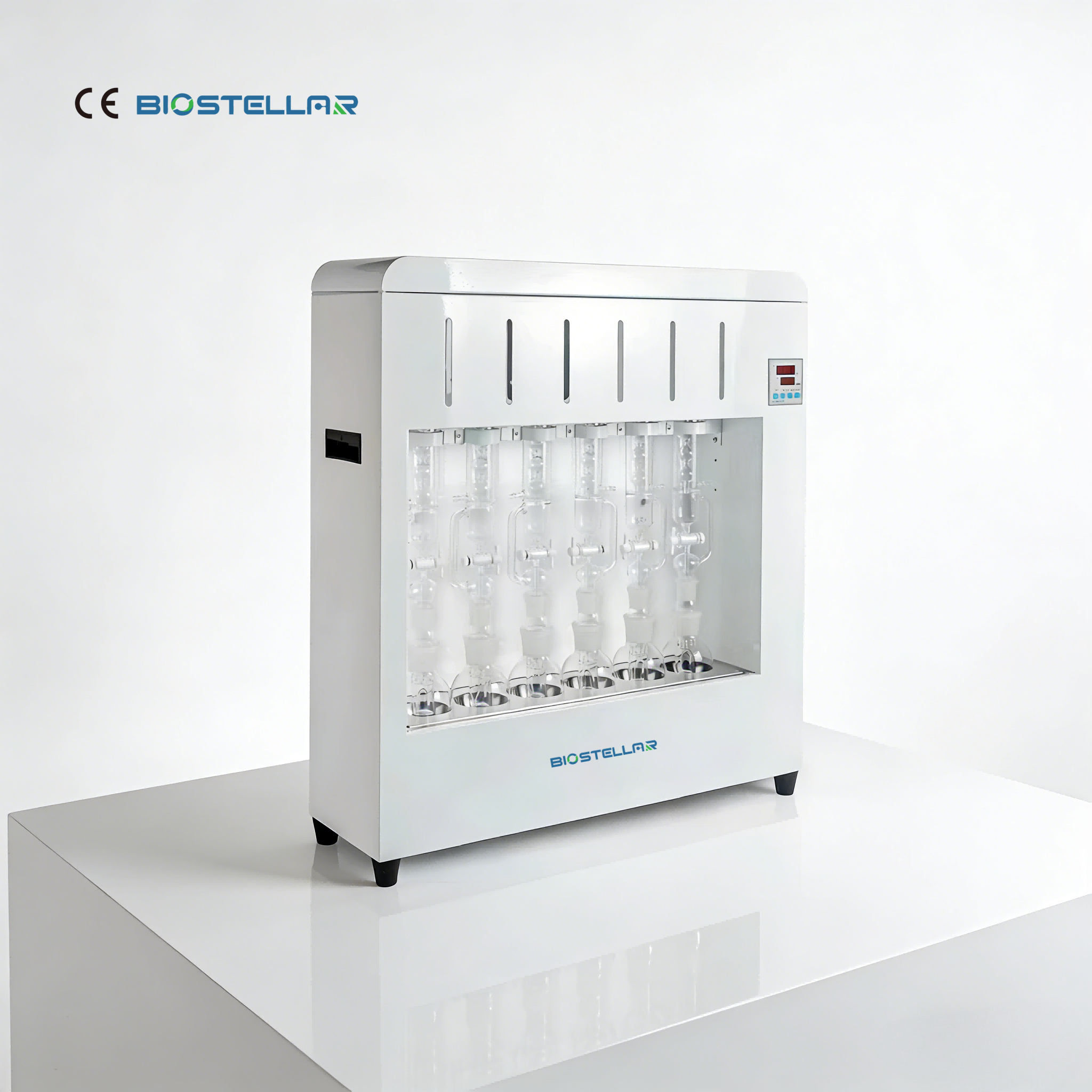
Soxhlet Extractor
Soxhlet extractor is composed of extraction bottle,extraction tube and condenser.During the operation,the heating temperature can be adjusted according to the different boiling point of the reagent and the ambient temperature.The sample is soaked and extracted repeatedly in the extraction process,so as to achieve the purpose of rapid determination.
Explore more
SEND INQUIRY

Mailbox
stellawang@biostellarlab.cn

+86-15666095066

+86-15666095066

Adress
HanYu Gold Valley.The Intersection Of 10 Run
Road And South ShunHua Road High-Tech
Zone.JiNan Shandong Province CHINA