SOLUTION DETAILS
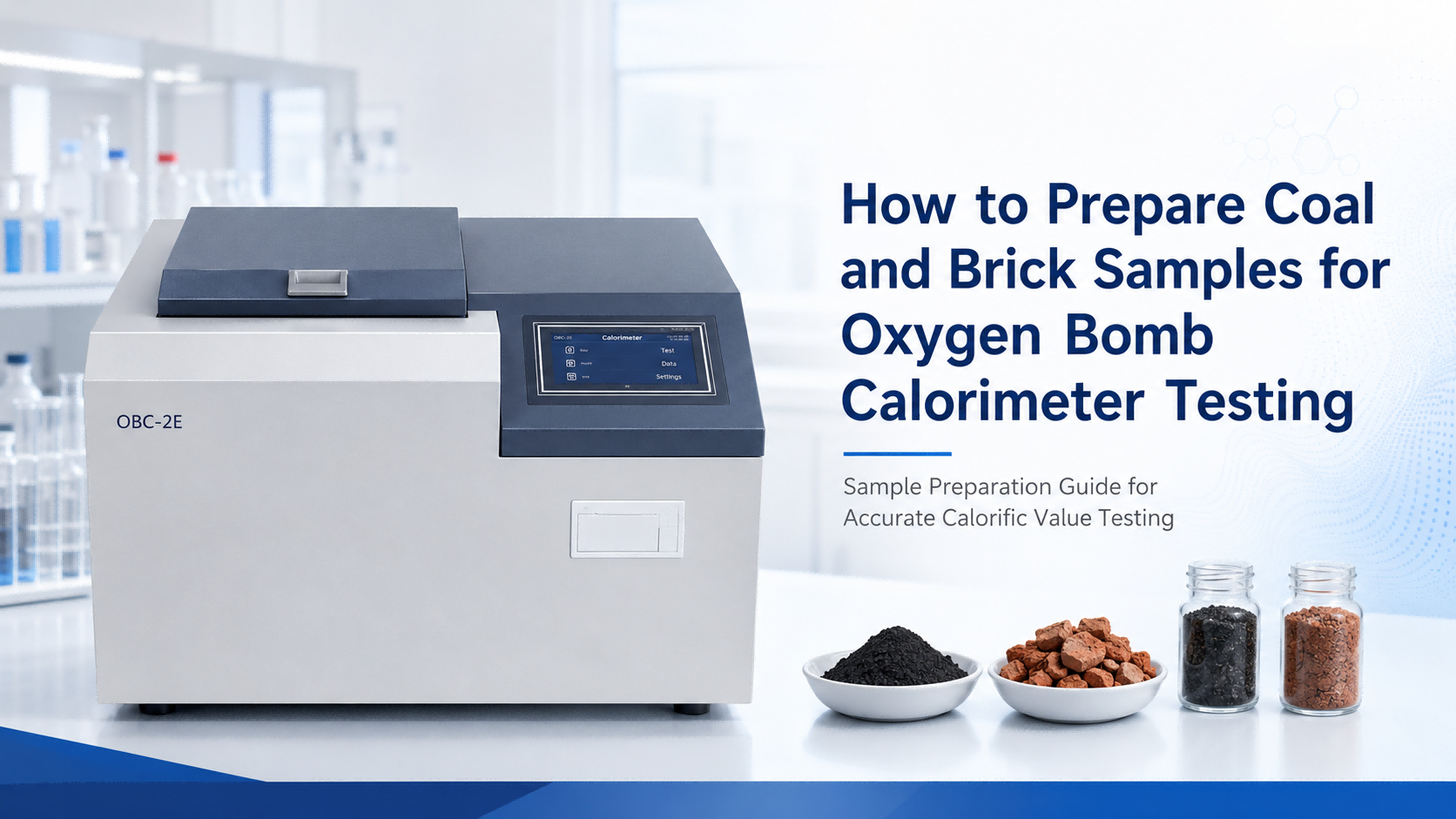
How to Prepare Coal and Brick Samples for Oxygen Bomb Calorimeter Testing
This article explains how to prepare coal and brick samples before oxygen bomb calorimeter testing.
In an oxygen bomb calorimeter, only a small amount of sample is burned inside the oxygen bomb. This small portion must represent the whole batch. If the sample is not homogeneous, the test result may be higher or lower than the actual average value.
Good sample preparation helps to:
Improve repeatability between tests
Ensure complete combustion inside the bomb
Reduce moisture-related errors
Avoid unburned residue after combustion
Improve ignition success rate
Make results more reliable for quality control and comparison
For coal and brick samples, the key preparation steps are usually drying, crushing, grinding, mixing, dividing, weighing, and selecting a proper ignition method.
2. Coal Sample Preparation for Bomb Calorimeter Testing
Coal is one of the most common samples tested by an oxygen bomb calorimeter. Since coal may contain moisture, ash, volatile matter, and particles of different sizes, it should be prepared carefully before testing.
Step 1: Collect a Representative Coal Sample
The collected coal sample should represent the whole batch. Avoid taking only large lumps, fine powder, wet portions, or surface material. If the coal comes from a bulk shipment, conveyor, storage pile, or production line, sampling should follow the applicable laboratory or industry standard.
Step 2: Air Dry the Coal Sample if Necessary
If the coal sample is visibly wet, it should be air dried before crushing and grinding. Excessive moisture may affect grinding efficiency, sample weighing, ignition, and final calorific value.
Do not use excessive heating unless the method allows it, because high temperature may cause loss of volatile components and affect the result. For routine calorific value testing, moisture should be controlled or measured according to the laboratory method.
Step 3: Crush and Reduce Particle Size
Large coal pieces should be crushed into smaller particles first. After crushing, the sample should be mixed and divided to obtain a smaller but representative portion.
The sample can then be ground into fine powder. A finer and more uniform particle size helps the coal burn more completely in the oxygen bomb. In many laboratories, coal samples are ground to around 0.2 mm or similar analytical fineness, depending on the test method and instrument requirements.
Step 4: Mix and Divide the Sample
After grinding, mix the coal powder thoroughly. Then divide it using a sample divider, quartering method, or other approved method. The purpose is to obtain a small analytical sample that still represents the original coal batch.
Do not take powder randomly from one corner of the container. Fine particles and dense particles may separate during handling, which can cause testing deviation.
Step 5: Weigh the Sample Accurately
For most oxygen bomb calorimeter tests, the coal sample weight is usually around 0.5–1.0 g, depending on the instrument model, expected calorific value, crucible size, and laboratory method.
Use an analytical balance and record the exact mass. Avoid spilling sample powder on the crucible wall, bomb head, or ignition wire holder.
Step 6: Place the Sample in the Crucible
Place the weighed coal powder evenly in the crucible. If the powder is very light, fluffy, or easy to scatter during oxygen filling, it can be pressed into a small pellet if the laboratory method allows.
The ignition wire or cotton thread should contact the sample properly. Poor contact may cause ignition failure or incomplete combustion.
3. Brick Sample Preparation for Bomb Calorimeter Testing
Brick samples are different from coal. Ordinary clay brick, ceramic brick, or refractory brick usually contains a high proportion of inorganic minerals. Some bricks may have very low calorific value or may not burn completely by themselves.
Bomb calorimeter testing is more meaningful for special brick or building material samples, such as:
Coal gangue brick
Sludge brick
Fly ash brick with organic residue
Construction waste materials
Insulation materials containing combustible additives
Brick samples used for fire testing or energy recovery evaluation
Step 1: Confirm the Purpose of Testing
Before testing brick samples, confirm whether the laboratory wants to measure:
Gross calorific value of the whole brick
Combustible content in the material
Energy value of additives or organic residue
Comparison between different brick formulations
Heat release potential of construction waste
If the brick is almost completely inorganic, the measured calorific value may be very low, unstable, or even affected by endothermic reactions.
Step 2: Remove Surface Contamination
Brush off dust, soil, coating, paint, cement, or other surface contaminants if they are not part of the sample to be tested. If the coating or surface layer must be included, record it clearly in the test report.
For accurate comparison, all samples should be treated in the same way.
Step 3: Break the Brick into Small Pieces
Use a hammer, jaw crusher, or suitable crushing equipment to break the brick into small pieces. Wear eye protection and dust protection during crushing.
For heterogeneous brick materials, take pieces from different positions of the brick, not only from one corner. This improves representativeness.
Step 4: Grind the Brick Sample into Fine Powder
After crushing, grind the brick pieces into fine powder. The finer the powder, the easier it is to mix and burn uniformly. For high-mineral samples, fine grinding is especially important because combustible components may be unevenly distributed.
After grinding, mix the powder thoroughly and divide it to obtain the analytical sample.
Step 5: Dry the Sample
Brick materials may absorb moisture. Moisture can reduce the measured calorific value and affect repeatability. Dry the sample according to the laboratory method, then cool it in a desiccator before weighing.
Do not overheat materials that may contain volatile organic components unless the test method specifically requires it.
Step 6: Decide Whether a Combustion Aid Is Needed
Many brick samples are difficult to ignite or have low calorific value. If the sample cannot burn completely by itself, a combustion aid may be required.
Common combustion aids include benzoic acid, paraffin oil, combustion capsules, or other approved auxiliary materials. The exact mass and calorific value of the combustion aid must be recorded, and its heat contribution must be subtracted during calculation.
For low-calorific-value brick samples, a blank test or control test may also be useful to confirm whether the result is meaningful.
Step 7: Check the Residue After Combustion
After the test, open the oxygen bomb carefully after pressure release and inspect the crucible and residue. If black particles, soot, or unburned material remain, the combustion may be incomplete.
Possible reasons include:
Sample particle size is too coarse
Sample contains too much moisture
Ignition wire does not contact the sample properly
Oxygen pressure is not suitable
Sample is too difficult to burn without combustion aid
Sample mass is too large
If incomplete combustion occurs, prepare a new sample and adjust the method.
4. Key Differences Between Coal and Brick Sample Treatment
Coal samples usually burn well and have a relatively high calorific value. The main focus is representative sampling, moisture control, fine grinding, and complete combustion.
Brick samples often contain large amounts of inorganic minerals and may have low heat release. The main focus is fine grinding, representative sampling from different parts, drying, and whether a combustion aid is necessary.
For coal, inaccurate results often come from moisture loss, poor mixing, or incomplete grinding. For brick, inaccurate results often come from low combustibility, uneven composition, and incorrect combustion aid correction.
5. Common Mistakes to Avoid
Do not test large lumps directly.
Do not use wet samples without moisture control.
Do not take sample powder from only one location in the container.
Do not overload the crucible.
Do not ignore unburned residue after testing.
Do not forget to deduct the heat value of ignition wire, cotton thread, capsule, or combustion aid.
Do not compare coal and brick samples using the same assumption, because their combustion behavior is very different.
6. Recommended Equipment for Sample Preparation
For a complete bomb calorimeter testing workflow, laboratories usually need:
Oxygen bomb calorimeter
Analytical balance
Sample crusher
Laboratory grinder or pulverizer
Drying oven
Desiccator
Sample divider
Crucibles
Ignition wire and cotton thread
Benzoic acid standard or combustion aid
A stable sample preparation process can greatly improve the accuracy and repeatability of calorific value testing.
Conclusion
Coal and brick samples require different preparation methods before oxygen bomb calorimeter testing. Coal samples should be dried, crushed, ground, mixed, divided, and accurately weighed to ensure complete combustion and repeatable calorific value results. Brick samples require more attention to representativeness, fine grinding, moisture control, and possible use of combustion aids because many brick materials contain high mineral content and low combustible matter.
For reliable results, laboratories should always follow the applicable test standard, instrument manual, and internal quality control procedure. Proper sample preparation is the foundation of accurate oxygen bomb calorimeter testing.
FAQ
1. Can brick samples be tested by an oxygen bomb calorimeter?
Yes, but it depends on the material. Brick samples containing combustible components, organic additives, coal gangue, sludge, or construction waste may be suitable. Ordinary inorganic bricks may have very low calorific value.
2. Does coal need to be dried before calorific value testing?
If the coal sample is wet or moisture needs to be controlled, drying or moisture correction is necessary according to the laboratory method. Moisture has a direct influence on calorific value results.
3. Why should the sample be ground before bomb calorimeter testing?
Grinding increases the surface area and improves sample uniformity. Fine and homogeneous powder helps the sample burn more completely.
4. What should I do if the brick sample cannot ignite?
A combustion aid may be used if allowed by the test method. The heat contribution of the combustion aid must be recorded and deducted from the final calculation.
5. Why is there black residue after the test?
Black residue usually indicates incomplete combustion. Possible causes include coarse particles, wet sample, poor ignition contact, insufficient oxygen, or unsuitable sample mass.
Share