


SOLUTION DETAILS
Optical Dissolved Oxygen Measurement: A Practical Choice for Low-Flow and Small-Volume Samples
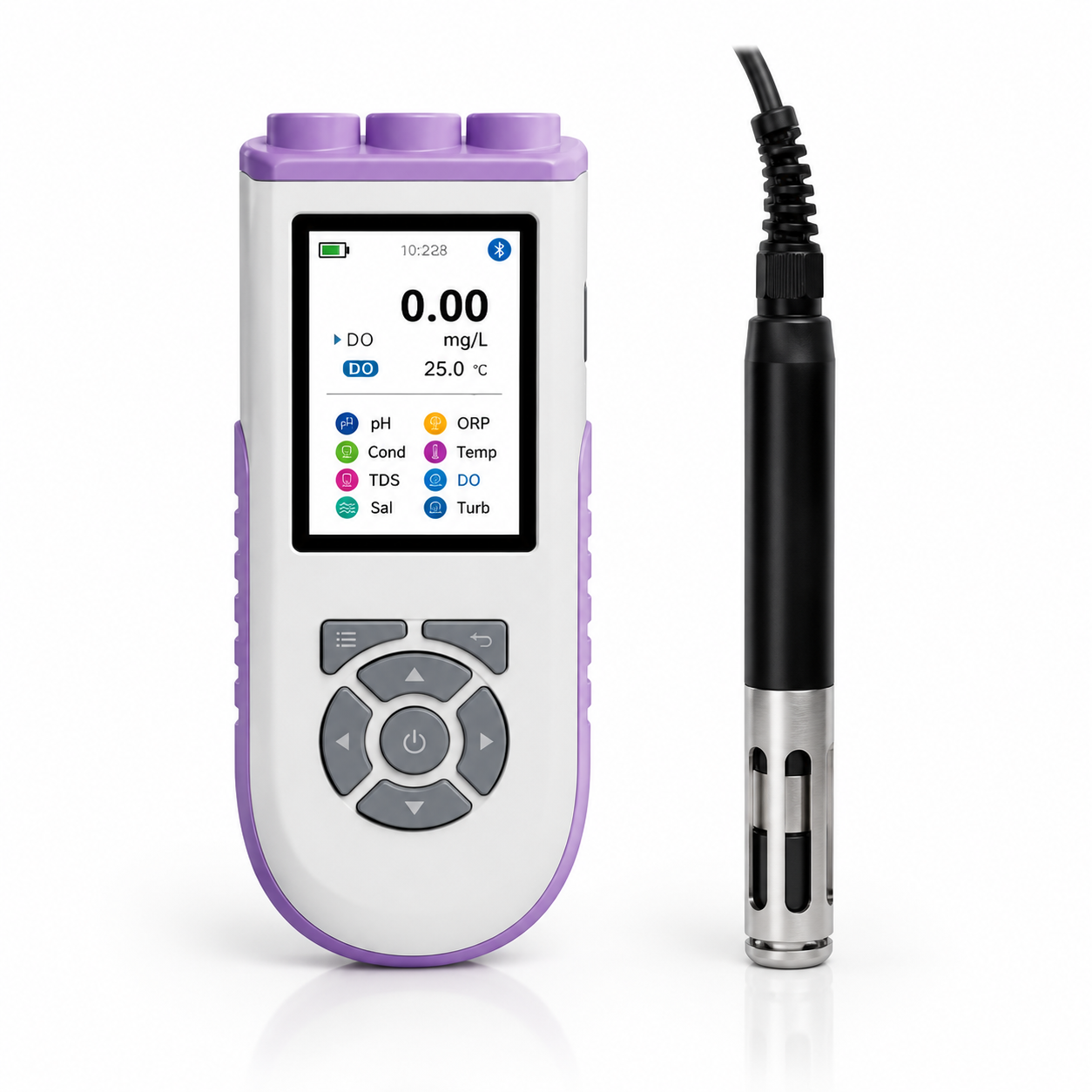
BIOSTELLAR optical dissolved oxygen meter and sensor
A dissolved oxygen reading is influenced not only by the sample, but also by how the sensor interacts with it. In a polarographic system, oxygen is reduced at the electrode during measurement. The sensor therefore consumes oxygen locally, and the sample normally needs continuous movement or stirring to replenish it.
What changes with optical DO measurement?
BIOSTELLAR’s optical dissolved oxygen configuration uses an oxygen-sensitive luminescent layer. Oxygen changes the light response of the sensing layer, allowing the instrument to determine dissolved oxygen without consuming the oxygen being measured. Because the method does not rely on an electrochemical reaction, it does not require electrolyte replenishment or continuous stirring for oxygen supply.
This measurement approach can be useful when working with low-flow water, low dissolved-oxygen levels or limited sample volumes, where maintaining a consistent flow may be inconvenient. It can also simplify routine work by reducing electrolyte-related service steps. The optical sensing cap remains a service component: inspect it, clean it and replace it in accordance with the instrument manual.
For samples containing sulfide or other potentially interfering substances, optical sensing may reduce some of the electrode-fouling concerns associated with conventional electrochemical probes. Actual suitability still depends on the sample matrix, probe materials and test method, so application compatibility should be confirmed before routine use.
Optical and polarographic methods at a glance
| Parameter | Polarographic DO | Optical DO |
|---|---|---|
| Measurement principle | Electrochemical oxygen reduction | Oxygen-sensitive luminescence response |
| Oxygen consumption | Consumes oxygen at the sensing electrode | Does not consume the oxygen being measured |
| Sample movement | Continuous stirring or flow is commonly required | No continuous stirring is generally required for oxygen replenishment |
| Electrolyte | Electrolyte solution and membrane need routine attention | No electrolyte solution to replenish |
| Sensor service | Membrane and electrolyte checks/replacement are part of maintenance | Optical cap requires inspection and periodic replacement as specified by the manual |
| Low-flow / small-volume work | Flow control is important because oxygen is consumed locally | Can be useful where continuous flow or stirring is inconvenient, subject to probe design |
| Sulfide-containing samples | Sulfide may foul or affect some electrochemical sensors | Often less susceptible to H₂S-related effects; confirm compatibility for the actual matrix |
Where this measurement approach may fit
Typical areas for optical DO measurement include water and wastewater monitoring, aquaculture, environmental sampling, laboratory water analysis and process-water checks. It is also worth considering for low-oxygen or small-volume samples when the probe geometry and measurement procedure are suitable.
- Water and wastewater monitoring
- Aquaculture and fish-farm water checks
- Environmental water sampling
- Laboratory water analysis
- Low-DO and small-volume sample workflows
Need configuration details or a quotation?
For electrode selection, technical documents, certificates, quotation or project support, contact Amy.
Amy
WhatsApp / WeChat: +86 156 6233 7510
Email: amy@biostellarlab.com
Contact Amy
Share



SEND INQUIRY

Mailbox
stellawang@biostellarlab.cn

+86-15666095066

+86-15666095066

Adress
HanYu Gold Valley.The Intersection Of 10 Run
Road And South ShunHua Road High-Tech
Zone.JiNan Shandong Province CHINA